
Fundratios is the charity fundraising benchmarking project which we operate in conjunction with the Institute of Fundraising.
Fundratios 2010 - Summary Report
1. Introduction and Overview
Fundratios is designed to help all charities, both large and small, to fundraise more effectively by producing a comprehensive analysis of all aspects of fundraising. This document summarises the key findings of the most recent project.
Twenty-nine charities with a total income of £1.7 billion participated in the study. Over 60% of those taking part had financial year-ends of March 2010 and 25% provided data for the 12 months to December 2009.
Of the £1.7 billion, £0.95 billion (59%) was derived from voluntary income; fees for services and grants provided 20% of total income, which was a lower proportion than in the previous year.
In the previous year's study (2009) we reported that charities had weathered the economic storm surprisingly well and on average achieved a 5.6% growth in Voluntary Income despite a modest fall in legacy income. The latest report suggests that 2009/10 was a more difficult period to achieve growth. Voluntary income rose by 2.4% in 2009/10 but this was in large measure due to a 6.8% rise in legacy income. Active fundraising rose by just 0.4%. Committed giving grew by 4% and direct marketing by 7% but local fundraising grew by less than 2%. The overall growth rate was impacted by sharp falls in major donors and emergency appeals, which perhaps in their nature are more likely to have peaks and troughs.
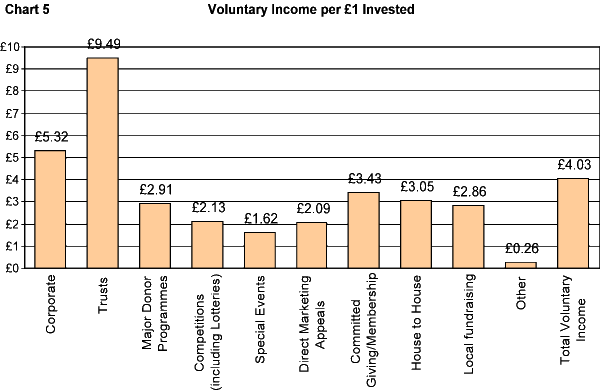
Return on investment was 7% lower at £2.97 per £1 invested in active fundraising or £4.03 if legacies are included.
2. Sources of Voluntary Income
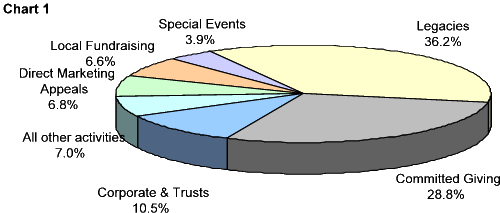
Chart 1 below shows a simplified analysis of the main sources of voluntary income. Legacies provided 36% of total voluntary income which was up from 35% on the previous year. The remaining 64% is actively fundraised, and, as discussed, achieved very little growth.
Of the actively fundraised sources, committed giving, which includes membership, is the largest sector. It received slightly less investment (-1.2%) in 2009/10 but generated 4% extra income and so improved its return on investment.
Direct marketing was the next largest single source providing 6.8% of the total voluntary income, followed by local fundraising at 6.6%, corporate at 6.2%, events and trusts at approximately 4% with competitions and major donor programmes each providing 2-3% of the total.
3. Revenue Growth
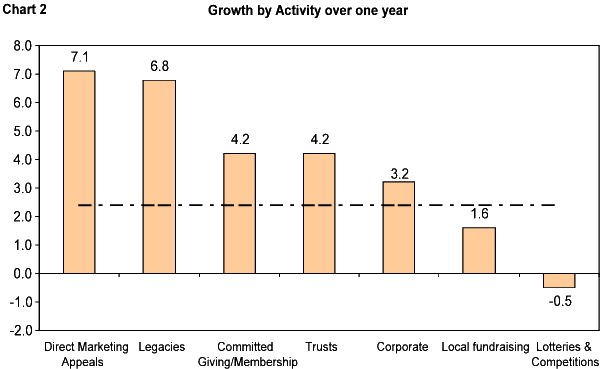
Legacy income increased by 6.8% after a drop of 3.4% in the previous year. The best growth for active fundraising came from direct marketing (+7%); committed giving, trusts and special events each achieved growth rates of 4%. Three large charities reported very big rises in major donor income in the previous year and this largely explained the 52% fall in 2009/10. Local fundraising enjoyed excellent growth in the previous year but this time it grew by only 1.6%.
The following chart shows growth by activity over the past year.
4. Fundraising Expenditure
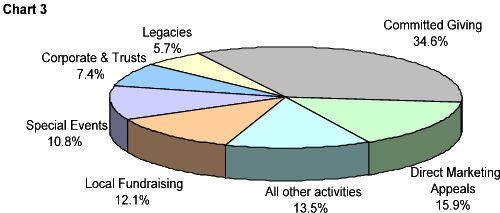
This chart shows the breakdown of total fundraising expenditure by category.
The standstill in actively raised income this year was despite additional resources being allocated. The charities in the study increased their expenditure by 3.8% (excluding legacy marketing) in order to achieve 0.4% growth in income. Looking at just the smaller charities in the report (voluntary income under £14m) expenditure was increased by 3% but income fell by 5%.
The lion's share of fundraising expenditure continued to be directed towards committed giving but after an 18% growth in the previous year, expenditure in 2009/10 was slightly lower. Local fundraising expenditure was 8% higher and extra investment was directed to special events.
The next table summarises the changes.
Analysis of Fundraising Expenditure
|
Activity |
Share of Budget |
Percentage Change |
|
Committed giving |
34.6 |
-1.2 |
|
Direct marketing appeals |
15.9 |
+0.6 |
|
Local fundraising |
12.1 |
+8.0 |
|
Special events |
10.8 |
+21.2 |
|
Competitions/lotteries |
6.5 |
-1.3 |
|
Corporate |
5.8 |
0.0 |
|
Legacies |
5.7 |
+32.9 |
|
Major donor programmes |
1.9 |
+2.2 |
|
Trusts |
1.6 |
+15.7 |
|
All other |
5.1 |
na |
|
|
|
|
5. Return on Investment
We have reported regularly on the slow but steady decline in return on fundraising investment since the late 1990s. With 3.8% more spend and only 0.4% more income that trend has continued with the average return on active fundraising this year being £2.97 compared with £3.19 per £1 invested last year. The rebound in legacy income helped to offset this and total return on investment was only 1% down at £4.03 from £4.06.
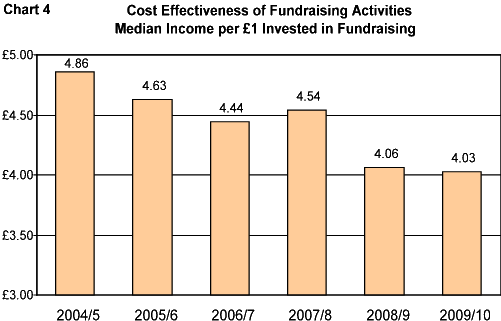
The dilemma that charities have faced for many years is to find the right balance between generating extra income on the one hand and lower returns on investment on the other hand. Committed giving has been a prime example; it has generated strong growth but at a steadily declining RoI. In 2009/10 expenditure was restrained and the RoI for committed giving improved to £3.43. Local fundraising, the second largest source of income had a return of £2.86. Other than legacies, with a return of £31.61, the best returns were from trust fundraising (£9.49) and corporate (£5.32) both of which improved in 2009/10.
The return on the main fundraising activities is shown below.
6. Highlights by Activity
Corporate
Corporate donations, sponsorship and payroll giving together provided 6.2% of voluntary income.
Perhaps in expectation that corporate donors would be difficult to recruit in the prevailing economic climate, no additional resources were allocated to corporate fundraising. Despite that, average growth of 3.2% was achieved and the median income per £1 invested was up at £5.32.
Eleven of the 29 charities reported income from "Corporate Charity of the Year" status and this represented 30% of total corporate donations. This year the average Charity of the Year donation was £52,000.
There was a 7% increase in income from corporate sponsorship and the typical return improved to £4.59 per £ spent.
Income from payroll giving fell by 1.6%. However, the average gift improved from £80 to £89 pa and although costs increased (from £10 to £14.20 per head) net income improved by 6.5% to £74.83 per donor.
Trusts
Total income from trusts income increased by 4.2%.
The return of £9.49 per £1 invested was almost 8% higher than last year. Average gift size was £5,800 (3% lower than the previous year). Nine charities reported that they received National Lottery funding with a median value of £520,000.
Major Donor Programmes
As in previous years, growth trends for major donor programmes can be heavily influenced by the results of just a few charities. In 2009/10 major donor income fell by 52%. However, in 2008/09, three of the charities in the Fundratios report benefited from very large donations. The average growth excluding those three charities was 13%. The overall return was £2.91 per £ of expenditure.
Legacies
Once again, legacies provided the largest single source of income, averaging 35% of voluntary income.
Income was up 6.8% over one year and 11.8% over the three years from 2006/7 to 2009/10. The average 3-year growth was 18.5% in the previous year’s Fundratios report and 20% in the year before that. Clearly the falls in property and stock market values during the recession will have had an impact on the value of residuary legacies. The average residuary legacy was 8% lower at £23,600.
Gaming, Lotteries and Competitions
Income from lotteries and competitions has shown very little growth in recent years and actually fell in both of the last two years. In total this type of fundraising generated 3.0% of voluntary income with 15 of the 29 charities running lotteries.
Income per £1 invested fell from £2.14 to £1.79.
Special Events
Income from special events increased by 4.1% but expenditure was 21% higher. The median return on investment fell from £1.98 to £1.62.
Mass participation events were increasingly popular amongst fundraisers and provided 43% of events income (37% last year) but at a reduced profit margin of 61% (70% last year).
Direct Marketing Appeals
This year, direct marketing income increased by 4.1% reversing a fall of 3.9% in the previous year.
Expenditure was almost unchanged (+0.6%) and as a result there was a modest improvement in return on investment from £1.94 to £2.09 per £1 spent. Despite the improvement, the initial rate of return is low compared to most of the other major activities although there may be longer-term benefits.
Warm direct mail achieved a higher response rate of 8.8% compared to 8.0% in the previous year but income per £1 invested slipped from £4.12 to £3.98. The response rate for cold mailing deteriorated from 1.1% to 0.9% and generated £0.52 per £1 invested i.e. a loss of £0.48 per £1 spent.
Committed Giving and Membership
Committed giving and membership provided 28.8% of voluntary income, or excluding legacies 45% of active fundraising income. Last year expenditure fell by 1.2% and income rose by 4.2% so that income per £ improved to £3.43.
There was a useful improvement in the average first year income per new giver from £33 to £48 and a reduction in acquisition cost from £101 per new giver to £87. Together these changes meant a welcome improvement in the balance between cost and first year income.
On average 12% of existing committed givers increased their contribution during the year compared to just 7% in the previous year. The average increase was £33 a year or just under £3 a month.
House-to-House Collections
This year's House to House collections provided only 0.2% of voluntary income. Income was just 1.0% up from the previous year despite a 5% increase in expenditure.
Local Fundraising
Income from local fundraising had been growing strongly in recent years but only by 1.6% in 2009/10. It provided 6.6% of income and made a return of £2.86 per £1 invested.
Donations and Gift Aid
Donations received, which could not be directly attributed to other fundraising activities such as membership or shops, amounted to 1.1% of voluntary income (1.3% last year).
This year, committed giving was 75% gift aided (76% last year). Direct marketing was 58% gift aided, (59% last year).
Tax recoveries from all sources provided 4.8% of voluntary income (4.2% last year).
Mail Order Trading
Income from mail order fell again in the latest year by 2.3% on average following the 13.2% decline in the previous year. Of the charities that provided data for mail order trading, 60% reported a decline in sales.
Return on investment improved to £1.53 per £1 of expenditure from the very poor level of £1.23 in the previous year. Response rates to the main catalogue improved for the second year running from 6.3% to 7.0%.
If your charity is interested in taking part in Fundratios and for further information on the project, please click here.