
Fundratios is the charity fundraising benchmarking project which we operate in conjunction with the Institute of Fundraising.
Fundratios 2008 - Summary Report
1. Introduction and Overview
Fundratios is designed to help all charities, both large and small, to fundraise more effectively by producing a comprehensive analysis of all aspects of fundraising. This document sets out to summarise the key findings of the study, in order for the results to be incorporated in fundraising activity.
Thirty-six charities with a total income of £2.5 billion participated in the study. Of this, the proportion derived from voluntary income was little changed from the previous year at 54% and fees for services and grants were, as usual, the second largest source.
The charities participating in the study enjoyed a reasonable year's fundraising, with voluntary income rising by 6.0%. However, this is largely due to a legacy income growth of 9.9%, whilst active fundraising rose by only 3.7%, less than half last year's rate. Although most major activities enjoyed some growth, the largest activities, committed giving and local fundraising, grew by less than 2%.
Return on investment was satisfactory at £3.20 per £1 invested in active fundraising or £4.54 if legacies are included, but the return on committed giving (the largest source of voluntary income after legacies) fell from £3.42 to £2.79.
2. Sources of Voluntary Income
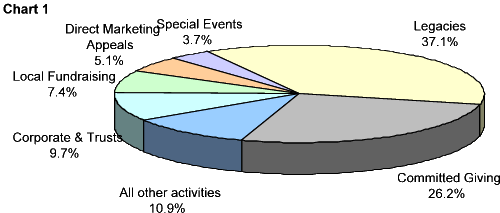
Chart 1 shows a simplified analysis of the main sources of voluntary income. Legacies provided 37% of total voluntary income and fortunately grew by 9.9% on the previous year’s figures. The remaining 63% is actively fundraised, with an annual growth of only 3.7%.
Of the actively fundraised sources, committed giving dominates but, despite substantial extra investment (see later), it grew by only 1.5%. However, given the relatively slow payback period often associated with this type of fundraising, the benefits may be seen next year.
Local fundraising was the next largest single source providing 7.4% of the total voluntary income, followed by corporate at 6% with direct marketing, special events, competitions, trusts and major donor programmes each providing less than 5% of the total.
3. Revenue Growth
Larger charities appear to have done better than smaller organisations this year. A major reason for this is that their legacy income grew by 12% whilst it fell by 8% in the case of smaller charities.
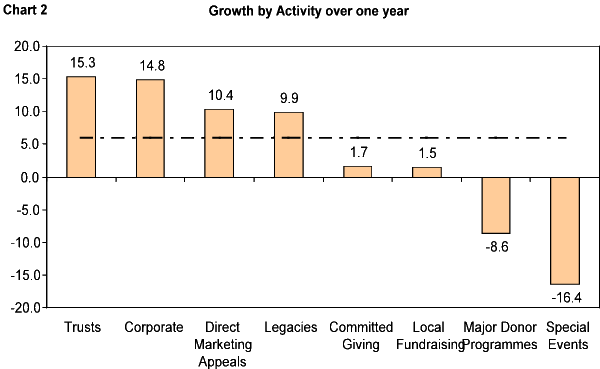
While legacies increased by 9.9%, active fundraising grew by only 3.7% over the same period. This is perhaps the most disappointing aspect of this year's study. The chart which follows shows growth rates for the year, by activity. This year's growth in active fundraising is the lowest since the turn of the century.
Slower growth in committed giving, which provides 41% of active fundraising income, was a major factor (up just 1.7%). In the past decade it had enjoyed double digit growth every year except 2005.
Three year growth of committed giving was 20% whereas in the recent past it was growing almost as fast annually.
Local fundraising, which enjoyed a renaissance in the previous two years, slowed to 1.5% and, although the sums are modest, house to house, major donor programmes and events suffered falls in income when compared to the previous year.
Best growth came from corporate, trusts and direct marketing appeals as illustrated by the following chart.
4. Fundraising Expenditure
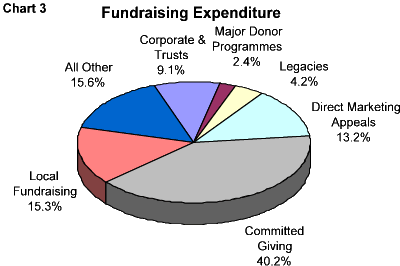
As noted previously, voluntary income arises from expenditure - or investment - on the part of charities and not vice versa.
The chart shows the allocation of the budget between various activities. Once again, committed giving took the lion's share (40.2%). Similarly it provided a significant proportion of non-legacy income, at 41.5% of the total.
For the first time in three years committed giving expenditure rose substantially, with a growth of 31%. We highlighted earlier that income from this source rose by just 1.7% but hopefully the benefit of the increased investment will be seen in the coming year. Direct marketing, income from which rose by 10.4%, was allocated 17.7% more funding than in the previous year and spending on corporate fundraising rose by 11.5%. Expenditure on special events was cut sharply (down 29%).
The next table summarises the changes.
Analysis of Fundraising Expenditure
|
Activity |
Share of Budget |
% increase (decrease) |
|
Committed giving |
40.2 |
30.6 |
|
Local fundraising |
15.3 |
1.9 |
|
Direct marketing appeals |
13.2 |
17.7 |
|
Special events |
7.7 |
(28.9) |
|
Corporate |
7.3 |
11.5 |
|
Legacies |
4.2 |
5.5 |
|
Major donor programmes |
2.4 |
14.4 |
|
Competitions/lotteries |
5.6 |
(2.4) |
|
Trusts |
1.8 |
3.8 |
|
All other |
2.4 |
na |
|
|
|
|
5. Return on Investment
As they spent 11% more and gained 6% more income, the charities in this year's study have experienced collectively a small drop in cost effectiveness. At individual charity level the extent varies greatly - according to their mix of income and the success or failure of their individual activities - so that the median i.e. middle result is marginally higher this year. This is also affected by the fact that more charities took part in the study this year.
However, if we take a longer term view it is clear that the returns currently being achieved, averaging some £4.50, are lower than in the late '90s/early 2000s when over £5 was the norm. In other words, charities have been successful at growing income but have had to spend more to do so. Nonetheless, net income (income minus cost of raising it) has still grown.
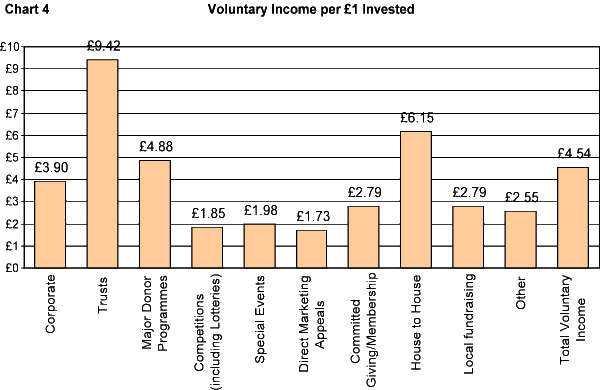
The return on the main fundraising activities is shown below.
6. Highlights by Activity
Corporate
Corporate donations, sponsorship and Payroll Giving together provided 6.0% of voluntary income, averaging £1.15m per charity for the group as a whole.
It was another successful year for corporate fundraising, with average growth of 14.8% in response to an 11.5% increase in expenditure. Income per £1 invested was £3.90.
Donations provided almost half of corporate income. Median growth of donations was 21.7% with several charities enjoying exceptional growth. 'Corporate Charity of the Year' status looks to have become increasingly valuable. This year, the income from this status averaged £82,000 compared with other donations that had an average of £2,500. There was an 11.9% rise in income from corporate sponsorship although the typical return was only £2.28 per £1 spent.
Income from affinity cards averaged £6.35 per card, higher than in recent years, but total income fell yet again - down 11.7% on the previous year’s figures.
There was a modest (3.2%) rise in Payroll Giving.
Trusts
For the first time in five years there was a satisfactory rise in income from trusts, averaging 15.3%. To put this in perspective, the three year average growth was just 8% while the median growth values are lower at 13.4% and 3.0% respectively; indeed for larger charities, the median growth over three years was -5.2% so the improvement was by no means uniform.
The return of £9.42 per £1 invested in trust fundraising was slightly higher than last year. Average gift size was approximately £4,000 and National Lottery funding provided a median 26% of trust income (for larger charities the median was 13% and for smaller charities it was 35%).
Major Donor Programmes
Last year it seemed that the time and money invested in developing major donor programmes was paying off with 77% growth and a return of £4.82. This year's results are disappointing with an overall drop in income of 8.6% although the return has held up well at £4.88. There was a marked difference between large and small charities with the former generally enjoying better growth and returns.
Legacies
Legacies still represent the largest single source of income, averaging 37.0% of the group’s voluntary income (36.3% last year).
Growth was 9.9% over one year, 19.9% over three years and longer term growth patterns for legacy income show a steady increase.
Residuary legacies of under £250,000 regularly provide some 70% of all legacy income with a typical value of £27,000.
Pecuniary legacies averaged £2,900 and half of all legacies came from known previous donors.
Gaming, Lotteries and Competitions
Lotteries and competitions provided 2.2% of voluntary income for the group as a whole this year, with just over half of the charities running lotteries. Growth was 0.3%, while expenditure fell 2.4%.
Income per £1 invested was £1.85.
Special Events
We commented last year on the apparently cyclical nature of spending on special events. Last year it soared 68% but this year it was reduced by 29%. Unsurprisingly, income fell by 16%; return on investment was £1.98.
Mass participation events were once again the major source of revenue (41%) with activity events providing a further 32%. Margins were 71% and 57% respectively.
Gala events provided only 12.5% of income this year with a 49% margin.
Direct Marketing Appeals
After a period of decline direct marketing appeals have produced valuable additional income for the third successive year.
The study shows that charities spent 17.5% more on direct marketing than in the previous year and income increased by 10.4%. Return on investment was £1.73 per £1 spent, the lowest rate of return of any major activity.
Smaller charities make greater use of direct marketing than the larger ones in the study, allocating a greater proportion of their budget to this area and, subsequently receiving a larger proportion of their voluntary income through direct marketing.
Once again, warm direct mail provided by far the major share of direct marketing income (72%), with all direct mail totalling 88% of income. Other media were used for the remaining 12% which was greater than in the previous year when they provided only 5%.
Warm direct mail made £3.07 per £1 invested from a 8.2% response rate, cold mailing made a return of £0.31, list exchange made £0.80 and other media £1.37.
Committed Giving and Membership
Committed giving has grown from a relatively minor source of income to become by far the largest source of non-legacy revenue. This year, it provided 26% of voluntary income or, excluding legacies, 41% of active fundraising income.
As there is a relatively long payback period with committed giving, the benefits of increased investment are frequently not seen until some time later. We hope that is the case this year, as expenditure increased by 31% but income rose by only 1.7%. The short term effect is to reduce the return from £3.42 last year to £2.79 this year.
Once again, face-to-face recruitment provided most new donors (27%) but the smaller charities used door-to-door to a greater extent (49%).
Not everyone could provide the detailed information on recruitment costs and attrition which we sought, so the data on these aspects needs to be viewed with caution. Nonetheless, the average recruitment cost of new givers this year was 150% of the average annual gift and for larger charities it was almost twice the average annual gift. This does point to declining margins on committed giving.
House-to-House Collections
This year, house-to-house collections provided only 0.4% of voluntary income. Income was down 8.6% over one year, 17.9% over three years and charities cut their expenditure by 13.3%.
Only two of the group raised more than £500,000 through such collections although they both made a very satisfactory return - which overall was £6.15 per £1 invested.
Local Fundraising
After a strong revival in the past two years, growth in local fundraising income this year was a modest 1.5% - much in line with the 1.9% rise in spend.
Local fundraising continues to provide 7.4% of income and made a return of £2.79 per £1 invested.
Donations and Gift Aid
Donations received which could not be directly attributed to other fundraising activities such as membership or shops, amounted to 1.8% of voluntary income, marginally less than last year.
This year committed giving was 76% Gift Aided, a figure which has steadily improved in recent years.
63% of donations from direct marketing were Gift Aided, up from 50% last year.
Tax recoveries from all sources provided 5.6% of voluntary income.
Shop Trading
There was no growth in income from shop trading this year and the typical return was down slightly at £1.17 per £1 invested.
Sales per shop averaged £76,000 and the typical profit was down at 11%.
Mail Order Trading
Mail order had another poor year with income down by 16.2%.
However it continues to make a profit (£1.45 per £1) and response rates, to the main catalogue, improved slightly to 5.4%.
If your charity is interested in taking part in Fundratios:
We will be marketing Fundratios 2009 shortly. For further information on the project, please click here.